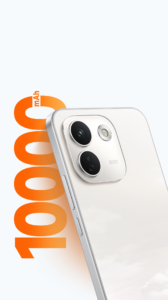
The Redmi Note line has always been about getting a lot for your money. This year Xiaomi added a new top model, the Redmi Note 17 Pro Max, and gave it the biggest battery the company has ever put in a phone. It trades the headline 200MP camera of past years for something more practical: endurance. Here’s what you need to know.
What’s New?
Xiaomi launched the Redmi Note 17 Pro and Pro Max globally on 27 August. The Pro Max is the first model in the Redmi Note series to use that name, since the top model used to be called the Pro Plus. It started at $499 globally, and in India it was priced at Rs 49,999 for 8GB + 256GB before offers, with sales beginning in late September.
Despite the huge battery, the design isn’t a brick. It measures about 163.4 x 78.3 mm and is around 8.6mm thick, and the weight is a little over 220g depending on the version. Colors are Cloud Blush, Green, Purple and Black. Cloud Blush has a photochromic finish that changes its look under sunlight, which is a fun touch.
Display
The screen is a 6.83-inch AMOLED with a 1.5K resolution (2772 x 1280), a 120Hz refresh rate and 12-bit color. Xiaomi quotes a peak brightness of up to 3,500 nits, so sunny days shouldn’t be a problem. It also supports HDR10+ and Dolby Vision, uses 3840Hz PWM dimming for easier viewing at low brightness and has a 3200Hz instantaneous touch sampling rate in Game Turbo mode.
Corning Gorilla Glass Victus 2 protects the front, and the in-display optical fingerprint sensor is quick and reliable.
Durability
This is a big upgrade for the series. The Pro Max lists IP66, IP68, IP69 and IP69K ratings, which means it can handle dust, immersion and even high-pressure, high-temperature water jets. It’s a level of protection you rarely see at this price.
Performance and Software
The Pro Max uses the Snapdragon 6 Gen 5, built on a 4nm process with a top clock speed of 2.6GHz. It comes with 8GB or 12GB of LPDDR5X RAM, and the 256GB and 512GB versions use fast UFS 4.1 storage, while the 128GB version uses slower UFS 2.2. Xiaomi also offers dynamic RAM extension, which borrows storage space to act as up to 24GB of memory.
It runs HyperOS 3 with six years of security updates. You also get Google Gemini, Circle to Search and Xiaomi’s AI tools like AI Erase Pro and AI Glare Removal. Connectivity is solid, with Wi-Fi 6, Bluetooth 6.0, NFC and dual SIM with eSIM support.
Camera
Xiaomi has moved away from the 200MP sensors of recent Pro models. The rear setup is now a 50MP main camera with OIS and an f/1.5 aperture, plus an 8MP ultrawide. The main sensor has larger 0.8µm pixels than the one on the standard Pro, which should help in low light. It records 4K video at 30fps.
The front camera is 32MP with an f/2.2 aperture and also records 4K video, which is nice for vlogs and video calls.
Battery and Charging
This is the headline feature. The battery is 10,000mAh and silicon-carbon, which is the biggest Xiaomi has ever used in a phone. In some regions the capacity is 9,210mAh, so check the version sold where you live. Charging is 100W with a 100W charger in the box in many markets, plus 27W reverse wired charging for topping up other devices.
Xiaomi claims up to three days of use on a charge, and says 20 minutes of charging gives you enough for a full day.
What You Might Not Like
- The Snapdragon 6 Gen 5 is a mid-range chip, so it’s not built for heavy gaming.
- No telephoto lens, and the ultrawide is only 8MP.
- Battery size and charger availability vary by region.
- It’s on the heavy side compared to most phones.
- The 128GB version uses slower storage than the 256GB and 512GB versions.
Who Should Buy It?
If battery life is your top priority and you want a bright screen, strong water resistance and solid everyday performance without paying flagship prices, the Redmi Note 17 Pro Max is a great pick. If you want the best camera or the fastest chip, spend a bit more on a flagship or a Poco F series phone.
| Feature | Details |
| Display | 6.83″ AMOLED, 120Hz, up to 3,500 nits peak |
| Resolution | 2772 x 1280 px (1.5K), 12-bit |
| Chip | Snapdragon 6 Gen 5 (4nm) |
| RAM | 8GB / 12GB LPDDR5X (up to 24GB with RAM extension) |
| Storage | 128GB (UFS 2.2) / 256GB and 512GB (UFS 4.1) |
| Rear Camera | 50MP main (OIS, f/1.5) + 8MP ultrawide |
| Front Camera | 32MP |
| Video | 4K at 30fps |
| Battery | 10,000mAh silicon-carbon (9,210mAh in some regions) |
| Charging | 100W wired, 27W reverse wired |
| OS | HyperOS 3, 6 years of security updates |
| Durability | IP66 / IP68 / IP69 / IP69K, Gorilla Glass Victus 2 |
| Connectivity | 5G, Wi-Fi 6, Bluetooth 6.0, NFC, dual SIM and eSIM |
| Colors | Cloud Blush, Green, Purple, Black |